Is this breed part of your dog’s ancestry?
Basepaws analyzes this breed as part of a group of other breeds.



Basepaws analyzes this breed as part of a group of other breeds.
Basepaws analyzes this breed as part of a group that also includes Keeshond, Kleinspitz, Mittelspitz, Pomeranian.
Despite being distinct in characteristics and origin, some pairs or groups of breeds lack the number of genetic differences required to distinguish these populations from one another, particularly when only a subset of these differences are inherited by a mixed breed dog. As we continue to expand our breed database, we aim to increase the resolution of our ancestry algorithm such that differentiating between increasingly specific ancestral sources becomes possible.
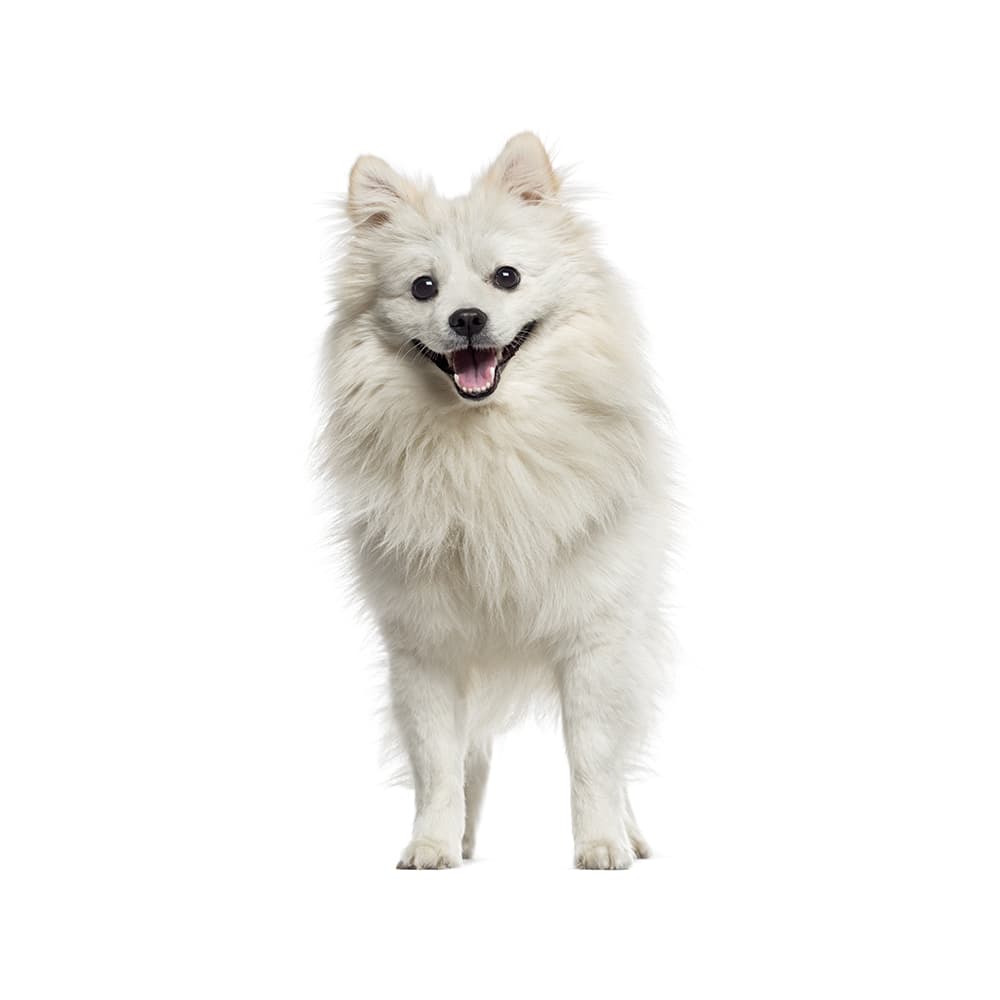
The Kleinspitz, also known as the German Small Spitz, was a guard dog used to keep mice and rats out of houses and stables. The Kleinspitz was bred in southern Germany, and served two purposes, as a watchdog and as a cute furry companion for women.
The Kleinspitz is a generally healthy breed, but can suffer from albinism (oculocutaneous), progressive retinal atrophy, thrombopathia, and von Willebrand disease (Type I and II). Genetic testing is recommended, including for the following additional conditions: hyperuricosuria, degenerative myelopathy, and progressive rod-cone degeneration.
The Kleinspitz is an intelligent breed that learns quickly. They respond well to motivation and are eager to please their owners. Socialization is important because this breed can be highly independent if not trained consistently. They tend to bark a lot, can be uneasy around strangers and lack hunting instincts which makes them ideal and effective guard dogs. When socialized early, they tend to be good with older children and other pets.
Before 1974, there was only one variety of "small" spitz which included the Kleinspitz and the Pomeranian. In 1974, the German Spitz club made a formal distinction between the two, separating them into different varieties based on size.
https://www.akc.org/dog-breeds/german-spitz/
https://vgl.ucdavis.edu/breed/standard-german-spitz https://www.fci.be/Nomenclature/Standards/097g05-en.pdf
Recommended by top vets with decades of experience
21 breeds
64 genetic health markers
50 genetic trait markers


Enter your email to receive a sample dog report and preview the breed and health insights inside.